
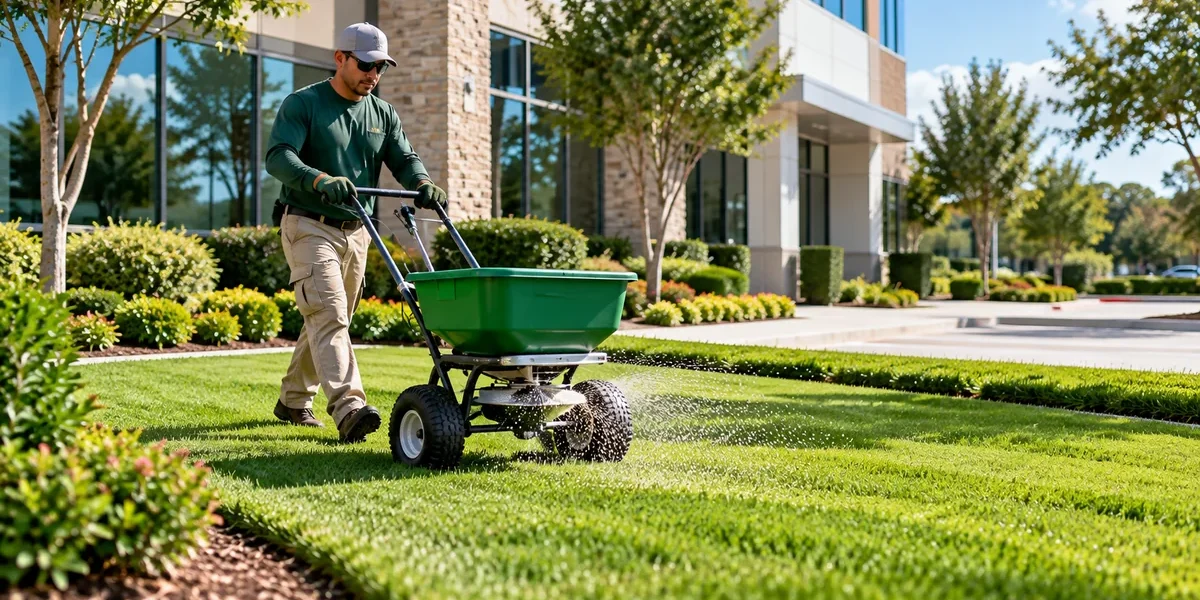
A commercial lawn can be mowed on schedule and still look thin, pale, or uneven. In Houston, warm-season turf has a long growing period, but heat, heavy rain, compacted soil, irrigation problems, shade, and repeated foot or vehicle traffic can all affect how well grass performs. That is why commercial turf fertilization Houston programs should be built around turf condition, growth, and soil needs rather than a one-size-fits-all calendar.
High Maintenance already includes fertilization and weed control within its commercial lawn maintenance in Houston services, making nutrient management part of a broader plan that also considers mowing, edging, irrigation, and site appearance.
Why Fertilization Matters on Commercial Properties
Turf at office buildings, retail centers, HOAs, apartment communities, and other commercial sites has to do more than survive. It frames entrances, borders sidewalks and parking areas, supports outdoor common spaces, and contributes to how maintained the property feels.
A well-managed fertilization program can support stronger color, denser growth, recovery from normal wear, and better competition against weeds. The goal is not to force excessive growth. It is to supply nutrients when the turf is actively able to use them.
Start With the Turf Type, Not the Fertilizer Bag
Houston commercial properties commonly use warm-season grasses such as St. Augustinegrass and bermudagrass. Their growth habits and nutrient needs are not identical, so an effective program begins by identifying what is actually growing on the site.
| Turf Consideration | Why It Matters to Fertilization |
| Grass species | St. Augustine and Bermuda can respond differently to nitrogen rate, mowing height, shade, and management intensity. |
| Sun vs. shade | Turf in heavy shade may need less nitrogen than high-visibility turf growing in full sun. |
| Soil condition | Soil pH and nutrient availability can affect how well turf uses what is applied. |
| Irrigation coverage | Fertilizer performs poorly when one zone stays too dry while another is constantly saturated. |
| Traffic and compaction | Entrances, courtyards, utility routes, and shortcut paths may need more than fertilizer to recover. |
Timing Matters More Than “Greening Up” Early
Texas A&M AgriLife guidance for warm-season turf emphasizes fertilizing when grass is actively growing and able to use nutrients. For St. Augustinegrass, spring fertilizer is generally delayed until the lawn has resumed active growth and has been mowed at least twice. Bermudagrass guidance follows a similar principle: do not make the first application while the lawn is still dormant.
For commercial sites, this approach helps property managers avoid paying for fertilizer that mainly feeds early weeds or sits where dormant turf cannot use it efficiently.
Signs a Commercial Lawn May Need a Fertility Review
Persistent pale color. Yellow-green turf can indicate nutrient issues, but it can also come from irrigation, drainage, disease, shade, or soil pH problems.
Thin turf that fills in slowly. Weak density can make weed pressure more visible and expose bare soil near curbs and walkways.
Uneven color across irrigation zones. The difference may point to water distribution before it points to fertilizer.
Heavy clipping growth after feeding. Excessive top growth can signal that the program is pushing more nitrogen than the site needs.
Repeated weed pressure. Thin or stressed turf leaves more space for weeds, even when herbicides are part of the program.
Why Soil Testing Can Save Money
A soil test helps show whether phosphorus, potassium, pH, or other factors actually need attention. Texas A&M AgriLife recommends soil testing as a foundation for efficient nutrient management rather than assuming every property needs the same fertilizer ratio.
For a property manager, that information can reduce unnecessary applications and help separate a true nutrient problem from irrigation, compaction, drainage, or disease symptoms.
Fertilizer and Irrigation Have to Work Together
Nutrients cannot correct a sprinkler system that misses half of a turf zone or floods the other half. After many granular applications, irrigation or rainfall is used to move nutrients into the soil, but excessive watering or a heavy storm can increase runoff and reduce efficiency.
That is why a fertilization program should be coordinated with commercial irrigation maintenance rather than scheduled independently. If brown zones, overspray, pooling water, or broken heads are present, those problems deserve attention before adding more fertilizer.
Fertilization Is Only One Part of Weed Control
Healthy, dense turf is one of the best long-term defenses against weed invasion, but weeds also have different life cycles. Some annual weeds are easier to prevent before they emerge, while existing weeds may require a targeted post-emergence approach.
A commercial maintenance plan works best when mowing height, irrigation, fertility, pre-emergent timing, spot treatments, and bed weed management are coordinated instead of handled as unrelated tasks.
Avoid the “More Fertilizer Must Be Better” Trap
Overfertilization can create rapid top growth, increase mowing demand, contribute to thatch or disease pressure, and waste material. Fertilizer that lands on sidewalks, curbs, or parking areas should be swept back onto turf rather than washed into storm drains.
For property managers, the better question is not “How much fertilizer can we apply?” It is “What does this turf need to remain dense, healthy, and presentable at the service level this property requires?”
How Fertilization Fits Into a Commercial Maintenance Plan
Identify turf and high-visibility zones. Entrances and street frontage may have different expectations than low-visibility utility areas.
Check soil and site conditions. Look at shade, drainage, compaction, irrigation coverage, and any repeated problem areas.
Time applications with active growth. Feed warm-season turf when it can use the nutrients rather than chasing early color.
Coordinate weed control. Use prevention and targeted treatments as part of the same annual program.
Document results. Compare color, density, weed pressure, mowing volume, irrigation demand, and recurring repair needs over time.
Build Turf Health Into the Whole Property Plan
Fertilizer can improve a commercial lawn, but it cannot compensate for poor mowing practices, broken irrigation, chronic shade, compacted soil, or drainage problems. The strongest results come from treating turf as one part of the entire landscape system.
Property managers can connect turf nutrition with full-service commercial landscaping in Houston and scheduled commercial lawn maintenance so the same team is watching mowing, turf color, weeds, irrigation, beds, and site presentation together.
Frequently Asked Questions
When should commercial turf be fertilized in Houston?
Warm-season turf should generally be fertilized after active spring growth has resumed rather than while the lawn is dormant. Exact timing and frequency depend on grass species, site conditions, management intensity, soil test results, and weather.
Will fertilizer fix yellow or thin commercial grass?
Sometimes nutrient deficiency contributes to poor color or density, but yellow or thin turf can also result from irrigation problems, shade, drainage, compaction, insects, disease, or mowing stress. A site evaluation should identify the cause before simply increasing fertilizer.
Should weed control and fertilization be done together?
They should be planned together even when they are applied at different times. Fertility, mowing, irrigation, and weed-management timing all affect turf density and weed pressure, so coordinating them usually produces a more consistent commercial lawn.